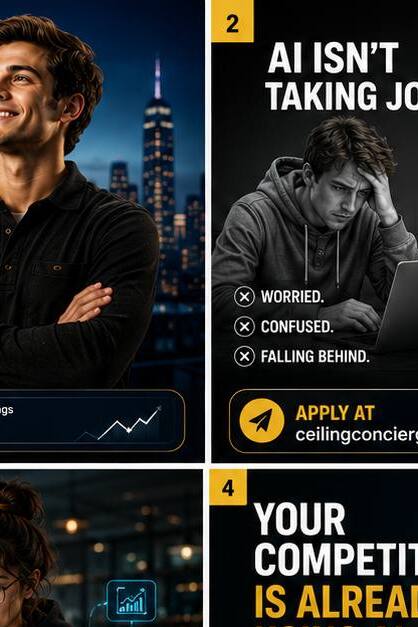
Walk into any college career fair in 2026 and you'll hear the same anxious question from students: "Is AI going to take my job?"
It's the wrong question.
The right question is this: If your classmate spends the next year learning to wield AI like a Swiss Army knife and you spend it doing the same homework you did in 2022, who do you think a hiring manager picks?
The Quiet Replacement
AI didn't show up and fire entry-level workers en masse. That's the Hollywood version. The real story is quieter and meaner.
What's actually happening: every job that used to need 3 people now needs 1 person plus the right tools. The 1 person isn't necessarily the most senior. They're the one who figured out how to use Claude to draft 40 cold emails in the time their coworker drafted 4. They're the one who built a Notion dashboard that runs on agent loops while everyone else opens a spreadsheet by hand. They're the one whose Midjourney workflow produces 12 ad concepts per day instead of 1.
That person didn't replace anybody. The other two seats just never opened up. The headcount that would have gone to them got absorbed by margin.
If you're a junior person reading this, you are competing for those single remaining seats. Your degree doesn't unlock them. Your GPA doesn't unlock them. Your willingness to learn the modern stack does.
The Skill Gap Is Wider Than You Think
We hire interns at Ceiling Concierge. We've talked to a lot of college students in the last 18 months. Here's the honest pattern:
- ~80% have used ChatGPT for an essay or a code question. That's it.
- ~15% have a workflow. They know how to chain prompts, structure context, get better outputs than someone hunting and pecking.
- ~5% can describe an agent loop, have written their own automation, or have a portfolio of AI-built things.
That last 5% gets hired. The rest competes for whatever is left.
This is not because the top 5% is smarter. It's because they understood, sometime around their sophomore year, that fluency in AI is now a literacy. The same way the last generation had to learn email and word processing. You don't get to opt out. You just get to be early or late.
What "Using AI" Actually Means
The phrase has been so overused that it's lost meaning. Let's get concrete. A person who "uses AI" at a professional level can do these things:
- Draft business communication at scale. Cold emails, follow-ups, proposals, contracts, blog posts. Not "I asked ChatGPT to write me an email" but "I have a 4-template system that I tune for industry, tone, and pain point, and I produce dozens of personalized variants per hour."
- Do research that used to take days in minutes. Pull a target list of 50 companies, find named executives at each, score them by fit, and have a working contact list in 90 minutes.
- Generate visuals. Midjourney, Canva AI, Figma's AI features. Build a slide deck, a one-pager, a social ad set, a landing page hero image without waiting on a designer.
- Automate repetitive tasks. Zapier, Make, Notion AI, custom scripts written by Claude. Their workflow runs in the background while they do higher-leverage work.
- Operate as a research analyst. Read 20 PDFs of an industry report, summarize the key findings, build a thesis, defend it with citations. All in one afternoon.
If you can't do any of these things, you are not "using AI." You are visiting it.
The Internship That Teaches This
We built our internship around this exact realization. The work is real, the pay is real, and the AI fluency is the curriculum.
Interns at Ceiling Concierge don't fetch coffee. They generate bid drafts using a library of templates and AI tools. They build outreach lists by combining web search, LinkedIn, and email-finder APIs. They write blog content (sometimes this kind), produce ad creative, and build landing pages. They learn how to talk to AI like a senior teammate would talk to a junior teammate: with context, constraints, and a clear definition of done.
By the end of the program, an intern with no prior experience has a portfolio that looks like a mid-career marketer's. They have receipts. They have a workflow. They have a body of work they can show in their next interview that no classmate can match.
The Choice
You can spend the next 12 months hoping the AI conversation blows over. It won't.
Or you can spend the next 12 months building a skill stack that puts you in the top 5% of your graduating class.
One of these choices results in a job offer in 2027. The other one results in another summer of "what now."
AI isn't replacing you. It's replacing the version of you that didn't learn it.
Ready to Build Your Future?
Apply for the Ceiling Concierge AI-First Internship. Real projects. Real pay. Real skills the classroom never taught you.
📧 Send your resume to info@ceilingconcierge.com
Or visit ceilingconcierge.com/internship.html