This article is for the parent reading this over the student's shoulder. It's for the aunt who keeps sending news clips about AI taking jobs. It's for anybody who looks at the AI conversation and feels their stomach drop.
I'm going to make you a promise: by the end of this piece, you will have a clearer way to think about AI than 90% of the people on cable news.
The Fear Is Real. The Conclusion Is Wrong.
Yes, AI is changing the economy. Yes, some jobs will disappear. Yes, the pace of change is faster than any previous technology shift.
But here's what the fear-merchants leave out: every prior wave of technology destroyed certain jobs and created new ones at a higher level of leverage. The car killed buggy whip makers. Email killed half the postal workforce. Excel destroyed the entire profession of "human calculator." Each time, the new jobs that emerged paid more and required more thinking than the ones that disappeared.
The thing that determined who won and who lost in each transition was a single variable: which workers adapted to the new tool, and which ones didn't.
The accountant who learned Excel in 1985 became more valuable. The accountant who refused became unemployable. Same job title, opposite outcomes.
That's what's happening with AI right now. Not "AI will take your kid's job." More like: "the version of your kid who uses AI will earn 2x the version of your kid who doesn't."
What This Looks Like in Practice
Let's get concrete. Imagine two 22-year-old marketing graduates.
Graduate A finished their degree in May 2026. They are afraid of AI. Their professors told them to avoid using ChatGPT because "it's cheating." They graduated with a portfolio of papers and a few group projects. They start applying for entry-level marketing jobs. The salary range they're seeing is $42K-$55K. They're competing with 200 other applicants for each opening.
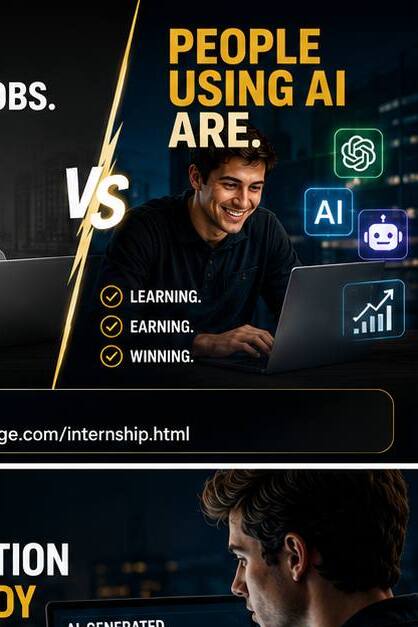
Graduate B finished the same degree. Sophomore year, they started using ChatGPT to study. Junior year, they took a paid internship at a company that used AI tools daily. They learned to write prompts, automate research, generate ad creative, build landing pages, and ship blog content. Their LinkedIn portfolio has 30+ public posts and 8 case studies. They graduate with a body of work, not just a transcript. They are applying for jobs in the $65K-$90K range, and many of those companies are reaching out to them.
Same degree. Same school. Same parents who love them. Wildly different outcomes.
The difference is not intelligence. It's not ambition. It's whether they made friends with the tool.
What "Learning AI" Actually Looks Like for a Student
The good news: your kid doesn't need to become a computer scientist. AI fluency is more like learning to drive than learning to build an engine.
Here's a 90-day plan you can hand to a college student today:
Days 1-30: Daily Use. Use ChatGPT or Claude every day for 30 days. Use it to study, write papers, plan trips, organize life. The goal is fluency, not novelty. By day 30, they should be able to write effective prompts without thinking about it.
Days 31-60: Real Projects. Pick something they actually want to build. A personal website. A class project. A startup idea. Use AI to build it end-to-end. Generate the content, design the visuals, write any code. Publish it.
Days 61-90: Get Paid. Take an internship, freelance gig, or paid project that uses AI tools daily. The fastest learning happens when other people are depending on the output.
That's it. 90 days, no special equipment, no expensive courses. Most colleges will not provide this. You may have to push your student to do it on their own.
What Parents Should Worry About Instead
Stop worrying about whether AI will take your kid's job. Start worrying about whether your kid is learning to use it.
Specifically, ask these three questions over Thanksgiving dinner this year:
- "What's your favorite AI tool right now?" If they say "I don't really use it," that's a five-alarm fire.
- "What's something you've built with AI in the last month?" If they can't think of anything, that's a yellow flag.
- "Where do you go when you want to learn how to use a new tool?" If they say YouTube tutorials, fine. If they say "I just ask Claude how to do it," they're in the right mindset.
These three questions are more diagnostic of your kid's career future than their GPA.
The Bottom Line
AI is not the end of opportunity. It is the largest opportunity expansion in 40 years for people who learn to use it.
The fear narrative is loud, but it's not telling you the whole story. The kids who succeed in 2030 are being made right now, in 2026, by their decisions to engage with these tools instead of avoiding them.
Make sure your kid is one of them.
Ready to Build Your Future?
Apply for the Ceiling Concierge AI-First Internship. Real projects. Real pay. Real skills the classroom never taught you.
📧 Send your resume to info@ceilingconcierge.com
Or visit ceilingconcierge.com/internship.html